

Case date: 29 September 2025
Abstract
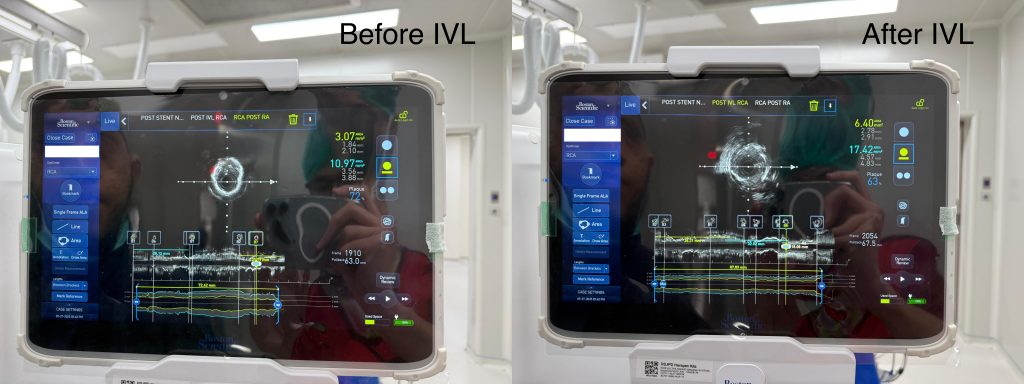
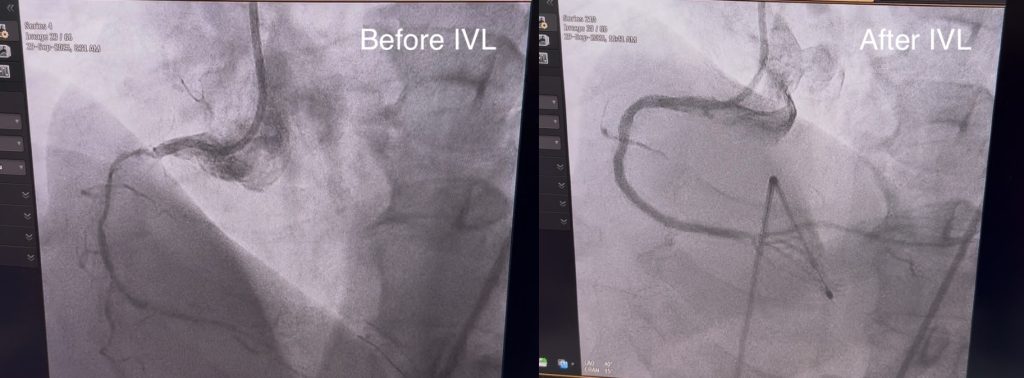
We present a case of intravascular lithotripsy (IVL) in a 63-year-old male patient. The patient presented with a CTO on the RCA (1VD CAD). A 3.00mm IVL catheter was used, delivering a total of 120 pulses throughout the RCA. The procedure was performed by dr. Amir Aziz Alkatiri, Sp.JP (K), FIHA at RSJPD Harapan Kita. The treatment resulted in a significant reduction in stenosis levels of the RCA. Additional stent implementation across three lesions sites were utilized. This case highlights the role of IVL in managing complex calcified vascular lesions.
Case Presentation
A 63-year-old male had a pre-procedural IVUS and angiographic imaging that revealed near CTO conditions throughout the RCA (1VD CAD).
The intervention was performed by Dr. dr. Amir Aziz Alkatiri, Sp.JP (K), FIHA at RSJPD Harapan Kita. After the initial usage of a rotational atherectomy and cutting balloon, the vessel was opened up to allow the guidewire for the IVL catheter to pass through. A Sonico-CX IVL 3.00 mm catheter was advanced across the lesion. After just 2 cycles (20 pulses), the vessel already showed signs of clearing up, although the maximum 120 pulses was applied to ensure no calcium deposit was left uncracked. Following this, stent implementations across three lesion sites were performed, ensuring maximal long-term vascular health.
Outcome
The procedure was successful, resulting in minimal final residual stenosis.
Discussion
This case demonstrates the effectiveness of IVL in treating heavily calcified coronary lesions.
In this patient, IVL allowed the clearance of calcium deposits in the vessel at CTO condition after the help of rotational atherectomy and cutting balloon. Our experience supports the role of IVL as a valuable tool in managing complex calcified disease.
Conclusion
Intravascular lithotripsy is a safe and effective method for modifying vascular calcium and optimizing outcomes in patients with complex calcified lesions. This case highlights its potential role as a frontline therapy in selected patients.
Leave a Reply